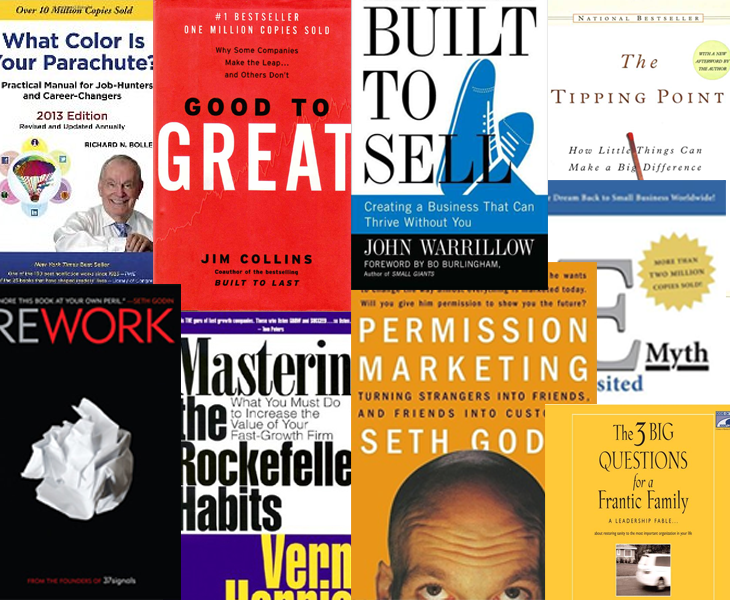
25 Best Business Books Ever

What makes a business book the “best”? Best-selling? Most influential? Timelessness? Categorical relevance?

Business Pundit sifted through numerous categories and resources to come up with this list of the 25 Best Business Books Ever. We didn’t concern ourselves with categories (management, sales, etc.) or timeliness of subject matter. Instead, we focused on the following question: Based on prominent reviews, academic use, and popularity, which business books would be considered “classics?” Of those, which are the best?

We think that really smart, successful businesspeople know that their education is lifelong and diverse. Nevertheless, while many corporate leaders will cite Sun Tzu’s The Art of War and Niccolò Machiavelli’s The Prince as invaluable business tomes, we stuck with books written for a business-minded readership.

25. The Wealth of Nations
by Adam Smith
1991

wealth_of_nations.jpg

First published in 1776, this broad-ranging exploration of commercial and economic first principles laid the philosophical foundations for modern capitalism and the free-market economy. Smith’s central thesis is that capital can best be used to create both individual and national wealth in conditions of minimal government interference. He believed that free-market competition advances both the vitality of commercial activity and the ultimate good of all a nation’s citizens.

24. The Functions of the Executive
by Chester I. Barnard
1968

function_of_the_executive.gif

This collection of Barnard’s lectures on management, though dated in its language, remains relevant, notably in his promotion of clear, short communication channels and managerial morality. A successful executive himself as well as a theorist, Barnard broadened the managerial role from one that assesses, controls, and supervises, to one that nurtures the organization’s values and goals, and translates them into action, thereby defining a purpose and moral code that pervades the organization.

23. The Principles of Scientific Management
by Frederick Winslow Taylor
1911

principles_of_scientific_mg.jpg

In its day, this book advanced management as a discrete field requiring formal training, and systematized human work into rigorously measured, optimizable processes.

Arguing that the “inefficiency in almost all of our daily acts” can be remedied by “systematic management, rather than in searching for some unusual or extraordinary man,” Taylor aimed to determine the best practices for every job. His principles influenced working methods and managerial attitudes for most of the 20th century, particularly in mass-production industries—companies that emphasize quantity over quality.

22. The Human Side of Enterprise
Douglas McGregor
1960

human_side_enterprise.jpg

Psychologist McGregor revolutionized human relations management by distinguishing the two ways managers view employees and consequently manage them, ultimately producing the accordant behavior in them. Theory X assumes that workers are inherently lazy and need to be motivated and supervised; Theory Y assumes that people are self-motivated and self-directed. “McGregor’s fundamental principles,” says author Gary Hamel, “underlie the work of modern management thinkers from Drucker to Deming to Peters, and the employment practices of the world’s most progressive and successful companies.”

21. Strategy and Structure: Chapters in the History of the Industrial Enterprise

by Alfred D. Chandler
1962

strategy_structure.jpg

A business historian, Chandler was one of the first scholars to systematically examine the corporate structure of large companies. Considered a theoretical masterpiece, this book—namely, its now-debated conclusion that strategy should drive structure—played a leading role in the profitable decentralization of leading corporations in the 1960s and 1970s.

20. Organizational Culture and Leadership
by Edgar H. Stein
1992

organizational-culture-and-leadershi.jpg

Organizational development pioneer Schein introduced, into the management debate, culture as a constantly changing force in an organization’s life—and one that must be understood for there to be successful change. In successive editions of this book, the author draws on contemporary research to redefine culture, including the notion of subcultures, and shows how to transform this abstract concept into a practical tool for understanding and influencing organizational dynamics.

19. The Wisdom of Crowds: Why the Many Are Smarter Than the Few and How Collective Wisdom Shapes Business, Economies, Societies and Nations
by James Surowieki
2004

the-wisdom-of-crowds.gif

First developed in his “Financial Page” column of The New Yorker, Surowieki’s ideas contradict the long-held distrust of masses and groupthink: “Large groups of people are smarter than an elite few, no matter how brilliant—better at solving problems, fostering innovation, coming to wise decisions, even predicting the future.” The author animates his rigorous argument with pertinent anecdotes and case studies from business, social psychology, sports, and everyday life. Author Po Bronson insists, “This book should be in every thinking businessperson’s library. Without exception.”

18. The World Is Flat: A Brief History of the Twenty-first Century
by Thomas L Friedman
2005

the_world_is_flat.jpg

New York Times columnist Thomas Friedman presents this timely, indispensable update on globalization, its successes and shortcomings, with the same urgent curiosity, panache, and illumination that has earned him three Pulitzer Prizes. With his incomparable ability to elucidate complex foreign policy and economic issues, Friedman explains how the flattening of the world happened at the beginning of the 21st century, and what globalization—both an opportunity and a threat—means to countries, companies, communities, and individuals. In his 2006 hardcover update, with 100 pages of revised and expanded material, Friedman makes specific recommendations about the technical and creative training he believes will be needed to compete in the New Middle class.

17. Barbarians at the Gate: The Fall of RJR Nabisco
by Bryan Burrough and John Helyar
1990

barbarians.jpg

This narrative has been called one of the most influential business books ever, as the definitive account of the largest takeover in Wall Street history at that time: the landmark leveraged buyout of the RJR Nabisco Corporation for $25 billion in 1988. Cinematic and gripping, yet remarkably judicious, this book by two skilled journalists has sold more than 500,000 copies and inspired an HBO movie. Its graphic portrayal of how financial operations at the highest levels are conducted is considered must-reading for those who want to know how the world really works.

16. My Years with General Motors
by Alfred P. Sloan, Jr.
1963

years_with_general_motors.jpg

Sloan’s “as told to” opus still stands as the most cogent expression of the managerial philosophy that dominated American business for most of the 20th century. With insightful authority, this fabled CEO chronicles General Motors’ resurrection, under his leadership, from a nearly bankrupt enterprise in the early 1900s to the world’s greatest industrial corporation when he retired in 1956.

Particularly striking is this book’s unintentional expression of a value system: a relentless commitment to the engineering worldview of efficiency as paramount. Sloan’s simultaneous decentralization of manufacturing and centralization of corporate policy and financial controls became the basis for an organizational model that dominated American industry for more than half a century.


15. The Fifth Discipline: The Art & Practice of the Learning Organization

by Peter M. Senge
1990

fifth_discipline.jpg

Based on 15 years of experience putting the ideas into practice, this bestselling classic popularized the concept of the learning organization, a holistic approach that prioritizes learning—new and expansive patterns of thinking—as both an individual and a group experience. Senge argues that “changing individuals so that they produce results they care about [and] accomplish things that are important to them” faster than the competiton does is, in the long run, the only sustainable competitive advantage.

Because the learning organization requires managers to surrender their traditional spheres of power and control, and because it demands trust, involvement, and the allowance for experimentation and failure, it has rarely been converted into a reality. Nevertheless, Senge’s ideas have affected the rewards and remuneration strategies of many companies.

14. The E-Myth Revisited: Why Most Small Business Don’t Work and What to Do about It
by Michael E. Gerber
1985

emyth_revisited_2.jpg

This underground bestseller dispels the commonplace assumptions surrounding starting and running a successful small business. Two of Gerber’s most incisive observations are that (1) many entrepreneurs know considerably more about producing what they sell than about operating their business, and (2) the entrepreneur must “work on your business, not in your business.” This book intelligently and comprehensively charts an approach to systematizing a new business so that it grows beyond the capacities of its creator.

13. The Tipping Point: How Little Things Can Make a Big Difference
by Malcolm Gladwell
2000

tipping_point.jpg

Drawing on a fascinating array of research findings and real-world examples, Gladwell presents a concise, elegant, erudite analysis of mass behavioral change that is strikingly counterintuitive. Regarded among marketing and sales professionals as one of the best books on the economics of popular culture, this entertaining read is, says author Jeffrey Toobin, “one of those rare books that changes the way you think about, well, everything.”

12. Competing for the Future
by Gary Hamel and C.K. Prahalad
1994

competing_for_the_future.jpg

This definitive book on contemporary business strategy criticizes the narrow mechanistic view of strategy and calls for an approach that is multifaceted, emotional as well as analytical, and concerned with meaning, purpose, and passion. The authors say their work “provides would-be revolutionaries with the tools and concepts they need to challenge the protectors of the past.” They argue that too many leaders, stuck in the day-to-day details of running their businesses, fail to prepare their companies for the future, and that crafting a strategic architecture around a company’s core competencies is the solution.

11. Good to Great: Why Some Companies Make the Leap…and Others Don’t
by Jim Collins
2001

good_to_great.jpg

Measuring sustained results over a period of 15 years, Collins identifies, from an original list of 1435, 11 well-established companies that made the leap from being “good” to being “great.”

Applicable to entrepreneurs as well as corporations, this carefully researched book singles out what Collins calls Level 5 Leadership—“a paradoxical blend of personal humility and professional will”—as the critical factor in those transformations. Such natural leaders “channel their ego needs away from themselves and into the larger goal of building a great company,” which begins with getting the right people—those with discipline and resolve—in the right positions. Challenging the conventional notion of the outgoing, high-profile CEO, an effective leader moves with selfless determination, inspiring average performers to become great producers.

There’s been a lot of controversy about this book on Business Pundit. Is Good to Great too general, too philosophical? Is its research flawed? Have Fannie Mae and Circuit City proven Level 5 principles wrong?

The book still found its place on this list based on our selection criteria. When we compiled these books and scrutinized Good to Great, we realized that it’s not the only classic subject to pointed—and valid–critiques. If we removed Good to Great from the list based on BP’s prior post, we’d have to remove a whole bunch of other books, too.

10. Out of the Crisis

by W. Edwards Deming
1982

out_of_the_crisis.JPG

This classic on quality management reflects Deming’s experience introducing statistical methods for quality measurement and improvement to Japan in the 1960s. Aiming to transform the U.S. style of management and governmental relations with industry, the author blends statistics and common sense to challenge American business practices at almost every point, launching the quality revolution here. Citing poor management, not lazy workers, as responsible for most quality problems, this book, in simple, direct language, offers a theory of management based on Deming’s notable 14 Points of Management, and explains how to apply them to boost quality.

9. Reengineering the Corporation: A Manifesto for Business Revolution
by Michael Hammer and James Champy
1993

reengineering_corporation.jpg

Though based on the relatively dry field of operations research, this book became a prominent bestseller in its heyday, replacing much of the received wisdom of the last 200 years of industrial management with a radical prescription for rebuilding businesses wholesale to achieve dramatic performance gains.

Unfortunately, this pioneering book garnered some controversy, largely because corporate cost-cutters used the concept of reengineering to justify mass layoffs. Acknowledging that reengineering can be difficult to launch and to sustain, the authors provide clear and specific guidelines, numerous examples, and in-depth case studies.

8. Built to Last: Successful Habits of Visionary Companies
by James C. Collins and Jerry I. Porras
1994

built_to_last.jpg

Drawing on six years of innovative research, Collins and Porras identify 18 exceptional, long-lasting companies and directly compare each with one of its top competitors, over time. With entertaining case histories, they discredit the longstanding beliefs that a successful business is founded by a charismatic, visionary leader and begins with a great product. Rather, they argue, enduring organizations demonstrate core values and a core purpose that remain fixed, while their business strategies and practices adapt endlessly to a changing world. Organized into a coherent framework of practical concepts that can be applied by managers and entrepreneurs at all levels, this book provides a master blueprint for building a great and enduring company.

7. The Practice of Management
by Peter F. Drucker
1954

practice-of-managment.jpg

Considered the foremost management and business thinker of the 20th century, Drucker was the first to depict management as a distinct function, a separate responsibility in the workplace: the work of getting work done through and with other people. This still-relevant book holds that management was one of the major social innovations of the last century, and it poses three now-classic business questions: What is our business? Who is our customer? What does our customer consider valuable?

According to author Gary Hamel, “No other writer has contributed as much to the professionalization of management as Peter Drucker. … [He] bridges the theoretical and the practical, the analytical and the emotive, the private and the social more perfectly than any other management writer.”

6. Competitive Strategy: Techniques for Analyzing Industries and Competitors

by Michael E. Porter
1980

competitive_strategy.jpg

Now in its 63rd printing in English, with translations in 19 languages, this modern classic filled a void in management thinking, transforming the theory, practice, and teaching of business strategy. Strikingly accessible, Porter’s analysis of industries captures the complexity of industry competition in three generic strategies and five competitive forces that have been internalized and applied by managers, investment analysts, consultants, students, and scholars throughout the world.

This seminal book changed conventional thinking around strategy, offering a method whereby a company can examine not just its particular industry but its place in it, that is, its essential differentiation from its competitors that can be sold to the customer. Author Gary Hamel says, “[I]t is an unfailing guide to whether some particular strategy, once articulated, can be counted on to produce worthwhile profits.”

5. The 7 Habits of Highly Effective People: Powerful Lessons in Personal Change
by Stephen R. Covey
1989

7-habits.gif

Having developed the concept of this groundbreaking, long-term bestseller by studying literature going back more than 200 years, Covey bases his approach on relatively immutable personal human values. Unlike many a self-improvement author, however, he doesn’t promise a quick fix; rather, he calls for a paradigm shift—a revolutionary change in one’s perceptions and interpretations of how the world works. And with different thinking comes different actions that will profoundly affect one’s productivity and effectiveness.

Be proactive. Begin with an end in mind. Put first things first. Think win/win. Seek first to understand. Synergize. Renewal. With penetrating insights and cogent anecdotes, Covey presents a highly structured, holistically integrated methodology for creating balance, and hence success, in one’s personal and professional lives.

4. The One-Minute Manager
by Kenneth H. Blanchard and Spencer Johnson
1981

one_minute_manager.jpg

Millions of managers in Fortune 500 companies and small businesses around the globe have followed the timeless principles of this first mega-bestselling business book, presented as a parable. Concisely elegant, this narrative reveals three practical management secrets: One-Minute Goals, One-Minute Praisings, and One-Minute Reprimands—a concept that has spawned numerous “One-Minute” titles, for endeavors from parenting to golfing.

Blanchard and Johnson ground their ideas in studies in medicine and the behavioral sciences to explain why the one-minute techniques work with so many people, in so many environments.

3. How to Win Friends & Influence People
by Dale Carnegie
1937

win_friends_influence_people.jpg

Having sold more than 15 million copies, this seminal self-improvement book continues to guide managers in the universal challenge of face-to-face communication.

A master of human nature, Carnegie advises that “[w]hen dealing with people, remember you are not dealing with creatures of logic, but with creatures of emotion, creatures bristling with prejudice, and motivated by pride and vanity.” He argues that success is only 15% professional knowledge; the remaining 85% is “the ability to express ideas, to assume leadership, and to arouse enthusiasm among people.”

2. The Innovator’s Dilemma: When New Technologies Cause Great Firms to Fail
by Clayton M. Christensen
1997

innovators_dillemma.jpg

Examining a variety of leading well-managed companies that have failed to capitalize on innovative technologies, Christensen explains, with striking clarity and style, how to manage breakthrough products successfully when customers may not be ready for them.

His argument that overdependence on customer needs, or on the most profitable products, can damage a company’s success challenges the marketing and customer service books that put customer focus at the top of the corporate agenda. Considered a paradigmatic marketing visionary, Christensen highlights the problems inherent in what appears to be sound decision making, and rigorously demonstrates that companies will fall behind if they fail to adapt or adopt new technologies that will meet customers’ unstated or future needs.

Illustrating his points with anecdotes of historical figures, business leaders, and ordinary folks, Carnegie instructs the reader in how to change people, how to win them over to your way of thinking, without causing offense or resentment, and without making them feel manipulated. He teaches these skills through the underlying principle that people want to feel important and appreciated. Carnegie was the first to create a flourishing, credible, long-term business out of his ideas.

1. In Search of Excellence: Lessons from America’s Best-Run Companies
by Thomas J. Peters and Robert H. Waterman, Jr.
1982

in_search_of_excellence.JPG

Highly influential when global competition, largely from Japan, had brought Western business to a low, this quintessential business book describes eight enduring management principles that made the forty-three companies surveyed “excellent.” The authors focus exclusively on big companies, namely big manufacturers, but ironically condemn the excesses of modern management practice and advocate a return to simpler virtues. They have since come to feel that their ideas are better embodied in smaller companies.

Through lively case studies, this very readable classic forces a look at the fundamentals, at “first principles” that give a company its soul: Attention to customers, an abiding concern for people (productivity through people), the celebration of trial and error. A driving force in the subsequent deluge of business books, this trailblazer established customer service as a key form of differentiation and advantage, and launched the author-as-consultant/speaker/celebrity phenomenon.

Sources: Perseus Publishing’s The Best Business Books Ever: The 100 Most Influential Management Books You’ll Never Have Time to Read, Forbes, Business Week, U.S. News & World Report, a variety of lists located around the Web, and our own subjective reading experiences.

Investment books recommended by Warren Buffett.


Subscribe

Comments

  1. Walonline's Gravatar Comment by Walonline on July 31st, 2008 at 8:08 am

    Normally, I enjoy reading this blog, but:

    “If we removed Good to Great from the list based on BP’s prior post, we’d have to remove a whole bunch of other books, too.”

    Doesn’t that mean that a lot of the “lessons” included in a management book are generally rubbish–more like one-off observations that only vaguely fit the situation’s context?

    I think a big problem with many popular business books is that authors too often confuse correlation of events with coincidence.

    In the case of Good-to-Great, the general idea is valid–that it takes a lot to improve marginally when you’re already a good company. Still publishing the book with an example such as Fannie Mae (who had a nasty accounting scandal recently, not to mention creation of many of these mortgage backed securities, leading to a bailout) is simply irresponsible!

    A book like this could easily be rewritten every five years with more topical examples. Maybe they could evaluate what caused the fall from “greatness” of other companies?

  2. Jenna's Gravatar Comment by Jenna on July 31st, 2008 at 10:05 am

    Speaking of The World Is Flat - his publisher, FSG, is giving away the book online this week in anticipation of his new book Hot, Flat, and Crowded: Why We Need a Green Revolution — and How It Can Renew America.

    http://www.thomaslfriedman.com

  3. Mike's Gravatar Comment by Mike on July 31st, 2008 at 2:22 pm

    Drea,

    A very interesting list. “In Search…” and “Reeingineering…” have largely been discredited, and I think a few others *cough*flat*cough* will not be remembered a few years from now.

    Mike

  4. Stuart Finlay's Gravatar Comment by Stuart Finlay on August 1st, 2008 at 12:48 am

    I would be interested to know how many people actually change their habits or do anything different after reading these types of books. They can often spark a person to ponder or think of ways of doing things differently, I just wonder if ultimately they ever make a real difference.
    Not intended as a cynical question, I recently published a book called What Would Churchill Do? Which analyses the skills Churchill used to help win WW2 and applies them to modern business? After selling 000’s of copies online and signing 000’s of copies on a recent book tour of the UK, I get lots of great feedback about how much people enjoyed my book, I just wonder that other than fattening my bank account and giving people an entertaining read do people actually change/improve as a result.

  5. Anthony Kuhn's Gravatar Comment by Anthony Kuhn on August 1st, 2008 at 10:18 am

    You’ve bitten off a large chunk to chew on, but after reading your list, I recommended the readers of my blog to come to BusinessPundit.com and check out your list. I also exhorted them to dust off their library cards and run to the nearest branch and check some of these out for end-of-summer reading! Thanks for the great selections, Drea!

  6. Tara Joyce's Gravatar Comment by Tara Joyce on August 1st, 2008 at 2:32 pm

    A good list. But I found a better one recently. The 77 Best Business Books in print.

    They break the list down by categories. For example, innovation or entrepreneurship. I found it to be a very comprehensive and useful list.

  7. Francisco Alvarez Cano's Gravatar Comment by Francisco Alvarez Cano on August 4th, 2008 at 6:31 am

    I wonder if Blue Ocean Strategy (Kim&Mauborgne) should be here instead, for instance, than In Search of Excellence. I have had the opportunity of talking to both Mr Peters and Ms Mauborgne (and also Mr. Porter) and I do think these kind of books get prestige according to the prestige the companies that follow the models these books describe may sustain themselves as leaders of their markets. I cannot remember at least one of the firms Peters mention in his first BS that mainteins its domain role; Kim&Mauborge analize this phenomenon, and concludes that it is not about the companies but the products where the excellence should be searched…

Leave a Reply