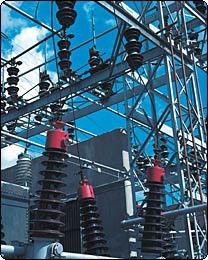
Texas Electricity Deregulation Leads to Highest Prices in the Nation

texas_electricity.jpg

From today’s Wall Street Journal:

Texas had some of the cheapest power rates in the country when it zapped most of the state’s electric regulations six years ago, convinced that rollicking competition would drive prices even lower.

This summer, electricity there is some of the nation’s priciest.

Power costs are rising in the rest of the U.S., but everything is bigger in Texas: On a hot day in May, wholesale prices rose briefly to more than $4 a kilowatt hour — about 40 times the national average.

Deregulation is was supposed to bring prices down. What happened?
The Journal’s research cites the following:

–Rising fuel costs are part of the problem (power generators use natural gas)
–Texas’ electricity demand is the highest in the nation. Is infrastructure wasn’t designed to accommodate the freewheeling demand, so there are transmission problems

After deregulating its electricity, Texas’ utilities companies saw several changes. A handful of electricity retailers and small businesses collapsed. They transferred customer accounts to bigger, more expensive retailers.

The plan that promised Texans more choices and lower rates has had the opposite effect. Poor planning (even Texas’ newer, more efficient plants still use natural gas), a free economy that created a rash of middlemen, many of them unexperienced, and expensive daily auctions add to the mess.

Question of the day: Can electricity successfully be deregulated? We’re going to face questions like these more and more as various energy industries pop up to replace oil.

I highly recommend reading the entire WSJ article here.

Have you read these books recommended by Warren Buffett.


Subscribe

Comments

  1. Dave's Gravatar Comment by Dave on July 17th, 2008 at 12:54 pm

    Deregulation doesn’t work with monopolies!!

  2. rat's Gravatar Comment by rat on July 17th, 2008 at 1:16 pm

    If this is anything like California’s “deregulation” it is actually a mixture of deregulating a few visible things while also increasing the regulations in other important areas, resulting in increased prices.

  3. matt's Gravatar Comment by matt on July 17th, 2008 at 2:08 pm

    I live in Dallas. I was on a month-to-month plan with Dynowatt. Last month my bill more than doubled to over $25.5 cents per kilowatt hour average. That’s over $250 for 1,000 KWh

    I signed a contract with another provider at $0.124 per KWh.

    The month-to-month plans are especially vulnerable to the spikes in wholesale prices noted above. This is why my bill was so high, and Dynowatt did send multiple notices explaining it. The collapses happen when providers like my new one sign too many contracts at too low a price, then the wholesale prices spike, causing them to be unable to clear their energy payments and go under. This switches you to a provider of last resort, usually at a surcharged rate. If this happens to you make sure you switch providers immediately.

  4. Jon's Gravatar Comment by Jon on July 17th, 2008 at 3:58 pm

    Sounds exactly like what we went through in California back in 2000 with Enron. Too bad not enough people in Texas noticed that.

  5. You Get What You Pay For's Gravatar Comment by You Get What You Pay For on July 17th, 2008 at 4:29 pm

    And the widest availability. And the fewest interruptions. With the least downtime. And with better responsiveness to customer requests, including “greener” generation of the electricity.

    Yeah, deregulation has sure messed things up (NOT!)

    You get what you pay for. Always have, always will.

  6. Deregulation allows true price's Gravatar Comment by Deregulation allows true price on July 17th, 2008 at 4:33 pm

    “Deregulation is supposed to bring prices down.”

    Who told you that? True deregulation allows the market to set the price, which reflects supply and demand. If there is a higher demand, expect higher prices.

    People in Venezeula pay 12 cents ($0.12) per gallon of gas. Why? Because the price is controlled, irrespective of supply and demand.

    That particular price control is bankrupting the country (Venezuela). They have to take loans internationally to subsidize the gasoline.

    Regulation (price controls) work great, until it all falls apart.

  7. Dan Cutts's Gravatar Comment by Dan Cutts on July 17th, 2008 at 6:06 pm

    Texas also has the most wind generation in the US, even green California can’t claim that. I myself can get full wind power for $.17 a kwh. Where else can you do that?

  8. TC's Gravatar Comment by TC on July 17th, 2008 at 11:32 pm

    TEXAS: Dude, I have to pay $40/kw

    California: ROTLOL! Is that all?? You noob!

  9. Pissed Off's Gravatar Comment by Pissed Off on July 20th, 2008 at 7:27 pm

    I live in a suburb of Dallas. My rate with Texas Power went up 55% in two months to 18.5 cents per KWH. I didnt have the hindsight to lock into a fixed plan, so now I am biting the bullet by switching to a fixed 14.5 cent provider (locked in for 3 years). This new rate still blows, but I am betting that 14.5 cents will be a bargain in Texas in the coming months. Also, even though I switched providers, it takes between 30 and 45 days for it to go through. So I am stuck paying 18.5 cents during the worst part of the year. Somebody needs to be hung over this.

  10. Vice's Gravatar Comment by Vice on July 24th, 2008 at 1:47 am

    My rate with Amigo (one of the suckiest provider’s in Houston) has gone progressively from 16.9 cents to 20.5 cents to now 24.5 cents. I learned I was on a fixed plan at 16.9 (after a year plus it escaped me being a new homeowner) so then signed up with Reliant who now on July 14th (best I can tell) is providing me electricity at 14.2 cents for 2 mths to then 15.8 for the 2 remaining yrs. It takes forever to switch! The PUC ought to be burned to the ground along with my friends at Amigo -just let me know where & when!

  11. Camie's Gravatar Comment by Camie on July 24th, 2008 at 2:07 am

    Ehh the first two reasons: high fuel costs and high per-capita energy use are the primary reasons for the high costs… not necessarily deregulation. I mean Texas might have had the highest costs in the nation by now if it had not been deregulated… it’s hard to know. Lack of transmission and lack of foresight by the state to encourage efficiency (California being the prime example, with flat per-capita electrical use since the 70s) dooms a state like Texas which faces insanely hot summers.

  12. Drea's Gravatar Comment by Drea on July 24th, 2008 at 9:50 am

    Thanks for your comments, folks. Good point about deregulation–it brings prices to market levels, not necessarily down. I meant to indicate that, according to my research, the people behind the deregulation sold it in part because people believed prices would decrease. So I changed “is” to “was,” in that spirit.

  13. John Johnson's Gravatar Comment by John Johnson on August 24th, 2008 at 3:36 pm

    If electricity deregulation is so good for me, why don’t I feel any better?

    I’m tired of hearing our elected officials tell us that electricity deregulation is working. It kills me to see that the Star-Telegram’s Mitch Schnurman is now buying into it. The rates I am paying rank me right up there with New York and New Jersey. Something is wrong. It is not working for me. How about you?

    The most recent Fortune Small Business magazine states that the national average for electricity is 8.9 cents per kwh. I’m currently paying 14.4 cents here in Arlington. The last time I checked, neither New York nor New Jersey had a nuclear power plant, and neither was sitting over any coal or natural gas. Something isn’t right.

    All the politicians who gave the power generating companies everything they asked for last legislative session, and, now, Mr. Schnurnam, say, “Yeah, we’re paying more, but look at all the positive things that are happening. We’re going to get new state of the art meters (we will be asked to pay more for them). New transmission lines are being built to handle wind generated electricity (we are being asked to pay for them). We’re pushing for more energy efficient appliances, and ONCOR has programs to help you improve your home’s energy efficiency (we pay for these upgrades and improvements).” We will use less electricity per household, but we will be paying about twice what we were for it before deregulation came to pass. Please show me your definition of “good”, Mr. Schnurnam. Good for who?

    One consultant quoted in Mr. Schnurnam’s piece says that Texas can meet future energy needs without building new generating plants if we fully implement all the efficiency programs available to us and continue to develop wind and solar options.

    This is just the opposite of what Rep. Phil King, head of our Regulated Industries Committee, recently conveyed to me. In his letter, he states that the current method of pricing is based on marginal fuel costs; a costing structure which allows the generating companies to not only cover expenses and build in a standard profit margin, but is “now designed so that private investors take the risk of investment on new power plants…and recover their much higher capital costs.” He is saying that the windfall profits going into the generating entities’ pockets is pre-paying for new power plants. If we’re not going to need many more of these expensive plants, are they going to send this money back to us?

    I bet that most of you have never even heard of the “marginal fuel equation”. This is the real culprit, and it is hardly ever discussed when the “why are my rates so high?” question is asked. Here’s what I know.

    Our elected “deal makers”, and our appointed Public Utilities Commission, allow the generating companies to charge all the energy they produce at whatever the cost is for the fuel that is the most expensive. For instance, ONCOR (the old TXU) generates electricity using three different types of fuel – natural gas, coal and nuclear. Coal and nuclear generated electricity is much, much cheaper to produce, yet they are allowed, under marginal fuel guidelines, to charge all at the much higher natural gas prices. ONCOR electricity is mostly generated using coal and nuclear power. There is no averaging.

    This would be similar to my taking off on a five day business trip. One night I stay in Temple and pay $75 for a motel room. The next two nights, I am in Waco and pay $100 per night. The last two, I am in Houston and pay $200 per night. This totals $675 for the week. When I get back, I turn in my expense report to the company for $1,000, showing that each night cost me $200. I stick the balance in my pocket. This is illegal. I call this stealing. Our “guardians” make it legal for ONCOR and others to do it.

    Do you see why the venture capitalist group that bought TXU was so willing to participate in the largest leveraged buyout ever? Why they were so anxious to “gamble” on the Texas market being lucrative and assume so much debt? It was a no-brainer! Literally billions of windfall profit dollars have gone into their pockets these last few months. All yanked directly from my pocket and yours.

    As far as I know, it is not mandated anywhere that this windfall go into any sort of escrow account designated for building new plants. I also know that this type of pricing is foreign to any other type of free enterprise business operation I am aware of, and I would suspect that ONCOR and others all have some sort of capital equipment/facilities recovery already build into their basic pricing structure, as is the norm.

    Mr. Schnurman does us all a great disservice when he pats the pirates on the back for anything included in the deregulation package. Number one, we are paying approximately 40% more than we should be for electricity. Number two, all the great little things he mentions in his article, we are going to pay “over and above for”. The energy companies aren’t “giving” us anything. We will have paid for all the research and development of these new technologies and we will have paid for the entire infrastructure related to their implementation. ONCOR will still be tucking away 40% more than they should be. Our rates will still be about twice what Oklahoma is paying.

    This is the root of the problem. This is reducing the situation to its lowest denominator. No one brings it up. No one wants to talk about it. I don’t even know if our elected officials understand it. If they do, they certainly don’t want to address it. We should all be trying to find out why.

Leave a Reply